
Understanding Swiss Machining: Precision for Complex, Small Parts
Swiss machining represents one of the most sophisticated precision manufacturing methods available today, especially for small, complex components that demand tight tolerances. Originally developed in Switzerland for the watchmaking industry (hence the name), Swiss CNC machining has evolved into a highly specialized process that excels at producing intricate parts with exceptional accuracy. For engineers and procurement teams evaluating manufacturing methods, understanding whether Swiss machining is appropriate for your specific application can significantly impact both part quality and production economics.
Unlike conventional turning operations, Swiss-style machining employs a unique guide bushing system that supports the workpiece close to the cutting tool, dramatically reducing deflection issues that plague traditional lathes when machining slender parts. This fundamental difference enables Swiss machines to consistently hold tolerances as tight as ±0.0001″ (2.5 microns) while efficiently producing parts with length-to-diameter ratios that would be challenging or impossible on conventional equipment.
In this comprehensive guide, we’ll explore the key design considerations that determine whether your component is an ideal candidate for Swiss machining, examine the technical advantages and limitations of the process, and provide practical guidance to help optimize your designs for Swiss production.
The Fundamental Principles of Swiss Machining
At its core, Swiss machining differs from conventional turning through its approach to workpiece support and material feeding. In a traditional CNC lathe, the workpiece is typically held in a chuck or collet, with the cutting tool moving to engage the material. This setup creates a cantilever effect where the material extends unsupported from the holding device, potentially causing deflection when machining forces are applied—particularly problematic for long, slender parts.
Swiss-style machines solve this fundamental problem through their distinctive guide bushing design. The material stock feeds through this precision bushing, which supports the workpiece precisely at the point of cutting. The cutting tools engage the material as it protrudes just beyond the bushing, virtually eliminating deflection. This design principle enables Swiss machines to maintain exceptional accuracy even when machining long, thin components with high length-to-diameter ratios.
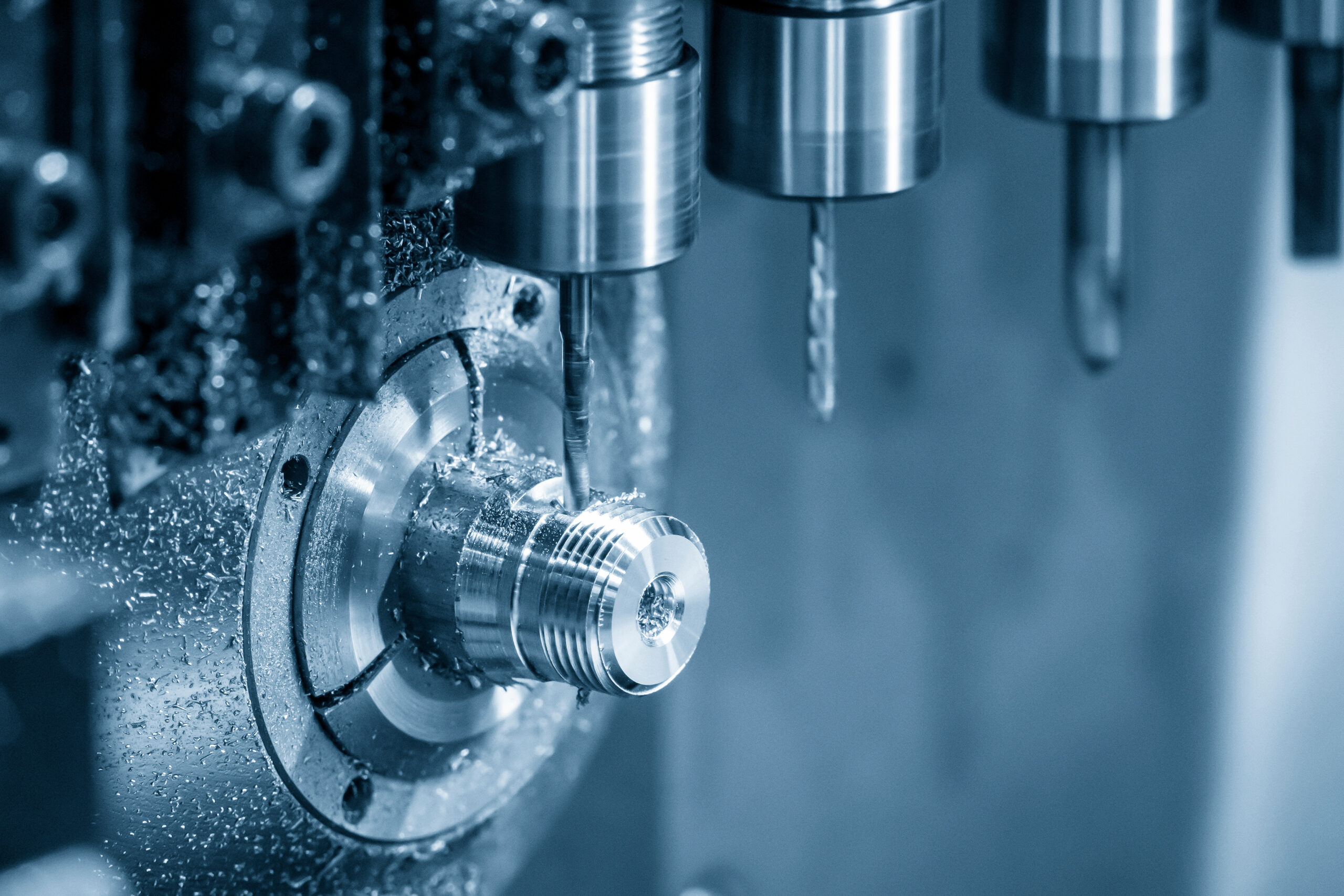
Modern Swiss machines typically feature a main spindle and sub-spindle arrangement, with multiple tool positions that can work simultaneously. This configuration allows for complex operations including turning, drilling, milling, thread cutting, and polygon forming—all in a single setup. Many advanced Swiss machines offer capabilities for 5-axis simultaneous machining, live tooling, and even Y-axis movement, expanding their versatility beyond simple turned components.
The material feeding system in Swiss machining is also distinctive. The headstock moves longitudinally to feed material through the guide bushing, rather than the tool moving along the Z-axis as in conventional lathes. This approach contributes to the exceptional precision of Swiss machines and enables the production of long, slender parts without sacrificing accuracy or surface finish quality.
Ideal Applications and Part Characteristics for Swiss Machining
Swiss CNC machining excels in specific applications where its unique capabilities provide significant advantages over conventional machining methods. Understanding these ideal use cases helps determine whether your part is well-suited for this specialized process.
Size Considerations
Swiss machines are optimized for smaller components, typically handling stock diameters ranging from 0.5mm to 38mm (0.02″ to 1.5″), though larger capacity machines exist. The sweet spot for Swiss machining generally falls between 1mm and 20mm (0.04″ to 0.8″) in diameter. Parts requiring larger diameters are usually better suited for conventional turning operations. The length capability of Swiss machines can extend to 300mm (12″) or more, making them particularly valuable for producing long, slender components with high length-to-diameter ratios—a scenario where conventional lathes struggle to maintain accuracy due to workpiece deflection.
Complexity and Feature Requirements
Components with multiple complex features are prime candidates for Swiss machining. The process excels at producing parts with intricate details including tight tolerance grooves, threads, cross-holes, flats, and contoured surfaces. Modern Swiss machines equipped with live tooling can perform milling operations, cross-drilling, and even polygon forming, allowing complex geometries to be completed in a single setup. This capability significantly reduces handling, improves dimensional relationships between features, and eliminates the stack-up errors that can occur when parts require multiple setups on different machines.
Tolerance and Surface Finish Requirements
When exceptional precision and superior surface finishes are required, Swiss machining offers distinct advantages. The process routinely achieves tolerances of ±0.0005″ (12.7 microns) and can reach ±0.0001″ (2.5 microns) in controlled environments. Surface finishes as fine as 0.2 Ra μm (8 μin) are achievable without secondary operations. These capabilities make Swiss machining particularly valuable for components used in medical devices, aerospace applications, precision instruments, and high-performance electronics where dimensional accuracy and surface quality are critical performance factors.
Material Compatibility with Swiss Machining
Swiss machining can process a wide range of materials, though certain characteristics make some materials more suitable than others. Understanding material compatibility helps determine whether Swiss machining is appropriate for your specific application.
Ideal Materials for Swiss Machining
Materials that machine cleanly with well-formed chips are particularly well-suited for Swiss machining. These include:
Brass and Free-Cutting Copper Alloys: These materials offer excellent machinability with clean chip breaking, making them ideal for Swiss operations. Their natural lubricity reduces tool wear and enables high surface finishes without excessive cutting forces.
Free-Machining Stainless Steels: Grades like 303 and 416 stainless contain additives (typically sulfur) that improve chip formation and reduce cutting forces, making them well-suited for Swiss machining while retaining good corrosion resistance.
Aluminum Alloys: Particularly the 2000, 6000, and 7000 series alloys machine exceptionally well on Swiss equipment. Their combination of good strength and excellent machinability makes them popular for precision components in various industries.
Medical-Grade Titanium: Despite being challenging to machine, titanium alloys like Ti-6Al-4V (Grade 5) can be effectively processed on Swiss machines when proper cutting parameters and tooling are employed. The exceptional surface finish capabilities of Swiss machining make it particularly valuable for medical implants and components.
Materials That Present Challenges
While Swiss machines can process most materials, some present particular challenges:
Gummy Materials: Certain grades of stainless steel (like 304 and 316), some nickel alloys, and soft aluminum can produce long, stringy chips that may wrap around the workpiece or tools. These materials often require specialized tooling, optimized cutting parameters, and sometimes high-pressure coolant systems to manage chip formation effectively.
Extremely Hard Materials: Materials exceeding 50-55 HRC hardness can accelerate tool wear and may require reduced cutting speeds, potentially impacting the economics of the Swiss machining process. However, modern Swiss machines with rigid construction and advanced tooling options can still effectively machine hardened materials when properly configured.
Abrasive Materials: Materials containing high silicon content or abrasive particles can cause accelerated wear on the guide bushing, potentially affecting dimensional stability during long production runs. Special bushing materials or designs may be required for these applications.
Design Optimization for Swiss Machining
To maximize the benefits of Swiss machining, engineers should consider several design optimization strategies that leverage the process’s unique capabilities while avoiding potential limitations.
Geometric Considerations
When designing parts for Swiss machining, certain geometric principles can significantly improve manufacturability and reduce costs:
Length-to-Diameter Ratio: While Swiss machines excel at producing slender parts, maintaining a reasonable L:D ratio improves stability and accuracy. For optimal results, consider designing with L:D ratios below 15:1 when possible, though ratios up to 30:1 can be accommodated with proper process controls.
Feature Sequencing: Arrange features in a logical sequence from one end of the part to the other when possible. This approach maximizes the efficiency of Swiss machining by allowing sequential operations without unnecessary tool changes or machine movements.
Minimize Deep Pockets: Deep internal features that require long, slender tooling can present challenges. When possible, design pockets with depth-to-width ratios less than 3:1 to improve tool rigidity and dimensional stability.
Undercuts and Back-Turning: Modern Swiss machines can effectively produce undercuts and back-turned features, but these operations may require specialized tooling or additional setup time. Consider whether such features are essential to part function or could be redesigned for more efficient production.
Tolerance Distribution
Strategic allocation of tolerances can optimize both part function and manufacturing economics:
Concentrate Tight Tolerances: While Swiss machining excels at holding tight tolerances, applying precision requirements only where functionally necessary reduces inspection requirements and improves manufacturing efficiency. Consider which dimensions truly require ±0.0005″ or tighter tolerances versus those that can accept more standard ±0.001″ or looser specifications.
Datum Selection: Carefully select datum features that align with the Swiss machining process. Cylindrical surfaces created by the main turning operation make excellent primary datums, as they typically exhibit the highest precision and concentricity.
Tolerance Stacking: Consider how tolerances stack across multiple features. The single-setup nature of Swiss machining helps minimize tolerance stacking issues compared to processes requiring multiple setups, but thoughtful GD&T application can further optimize results.
Economic Considerations: When Swiss Machining Makes Financial Sense
Beyond technical considerations, economic factors play a crucial role in determining whether Swiss machining is appropriate for your application. Understanding the cost drivers helps make informed decisions about manufacturing methods.
Production Volume Considerations
Swiss machining economics vary significantly based on production quantities:
Low Volume Production (1-100 pieces): For very small quantities, the setup time and programming complexity of Swiss machines can make them less economical than simpler conventional machining processes unless the part geometry specifically requires Swiss capabilities. Setup times typically range from 2-8 hours depending on part complexity, representing significant cost allocation when amortized across small quantities.
Medium Volume Production (100-10,000 pieces): This range often represents the sweet spot for Swiss machining economics. The initial setup costs are offset by the high production efficiency, reduced cycle times, and elimination of secondary operations. For parts in this volume range, Swiss machining frequently offers the optimal balance of quality and cost-effectiveness.
High Volume Production (>10,000 pieces): At very high volumes, Swiss machining continues to offer excellent economics, particularly for complex parts requiring tight tolerances. The process efficiency, minimal handling requirements, and consistent quality make Swiss machines ideal for high-volume precision components. For extremely high volumes (millions of pieces), alternative processes like progressive stamping or metal injection molding might become competitive, but Swiss machining remains advantageous for parts with complex geometries or tight tolerances.
Material Cost Factors
Material considerations significantly impact Swiss machining economics:
Material Utilization: Swiss machining typically requires bar stock that extends through the guide bushing, resulting in some material waste at the end of each bar (typically 4-12 inches depending on machine configuration). For expensive materials like medical-grade titanium or exotic alloys, this end-of-bar waste can represent meaningful cost. Optimizing production planning to minimize these remnants becomes increasingly important as material costs rise.
Material Form: Swiss machines typically use round bar stock, though hexagonal and square stock can be accommodated on some equipment. If your design starts from a non-round cross-section, consider whether redesigning for round stock might improve manufacturing economics without compromising functionality.
Material Certification Requirements: For regulated industries like medical and aerospace, material traceability and certification requirements add cost regardless of the manufacturing method. However, Swiss machining’s efficiency in producing complex parts from bar stock can simplify material traceability compared to processes requiring multiple material forms or joining operations.
Comparing Swiss Machining to Alternative Manufacturing Methods
To make an informed decision about whether Swiss machining is right for your part, it’s valuable to understand how it compares to alternative manufacturing processes for small, precise components.
Swiss Machining vs. Conventional CNC Turning
While both processes produce turned components, they differ significantly in capabilities and economics:
Precision and Stability: Swiss machining’s guide bushing system provides superior support for the workpiece, enabling tighter tolerances (typically ±0.0005″ vs. ±0.001″ for conventional turning) and better surface finishes, particularly on long, slender parts. Conventional turning struggles with workpiece deflection when L:D ratios exceed approximately 4:1, while Swiss machining remains stable with ratios up to 30:1.
Complexity Handling: Modern Swiss machines typically offer more tool positions and simultaneous operations than conventional lathes, enabling more complex parts to be completed in a single setup. This capability reduces handling, improves feature-to-feature relationships, and eliminates the need for multiple operations on different machines.
Production Efficiency: For simple, short parts with loose tolerances and low L:D ratios, conventional turning may offer better economics due to simpler setup and programming. However, as part complexity increases, Swiss machining typically provides superior cycle times and reduced secondary operations, improving overall efficiency.
Swiss Machining vs. Multi-Axis Milling
For certain complex components, both Swiss machining and multi-axis milling might be considered:
Geometry Limitations: Swiss machining excels at producing parts with rotational symmetry and features arranged around a central axis, while multi-axis milling offers greater flexibility for complex 3D geometries with features distributed across multiple planes. The choice often depends on whether the part geometry is fundamentally cylindrical (favoring Swiss) or prismatic (favoring milling).
Material Removal Efficiency: For parts requiring extensive material removal from solid stock, multi-axis milling may be less efficient than Swiss machining, which produces near-net-shape components with minimal waste. Swiss machining’s ability to complete complex turned features in a single pass often provides cycle time advantages for appropriate geometries.
Surface Finish: Swiss machining typically achieves superior surface finishes on cylindrical surfaces compared to milled surfaces, often eliminating the need for secondary finishing operations. This advantage can be particularly important for components with critical sealing surfaces or precise fitting requirements.
Case Studies: Successful Applications of Swiss Machining
Examining real-world applications helps illustrate when Swiss machining provides optimal solutions for manufacturing challenges.
Medical Device Components
The medical device industry represents one of the largest markets for Swiss machining due to its demanding requirements for precision, quality, and biocompatibility:
Bone Screws: These orthopedic implants typically feature complex thread forms, drive features, and precise tip geometries. Swiss machining produces these components from medical-grade titanium or stainless steel with the required dimensional accuracy and surface finish to ensure proper function and biocompatibility. The process completes these components in a single setup, maintaining critical relationships between features and eliminating the contamination risks associated with multiple handling steps.
Surgical Instrument Components: Items like endoscopic end-effectors, biopsy device components, and minimally invasive surgical tools often require complex features on small-diameter components. Swiss machining’s ability to produce intricate details on small parts makes it ideal for these applications, where conventional machining would struggle to maintain the required precision.
Aerospace and Defense Applications
The aerospace industry relies on Swiss machining for critical components requiring exceptional reliability:
Fluid Control Components: Hydraulic and pneumatic system components like valve spools, orifices, and precision fittings benefit from Swiss machining’s ability to maintain tight tolerances on critical sealing surfaces. These components often feature complex internal passages and precise dimensional relationships that would be difficult to achieve with conventional machining processes.
Electrical Connectors: High-reliability electrical connectors used in aerospace applications require precise dimensions to ensure proper mating and electrical contact. Swiss machining produces these components with the necessary precision while maintaining the surface quality needed for plating operations and electrical performance.
Common Challenges and Solutions in Swiss Machining
Understanding potential challenges in Swiss machining helps engineers design parts that avoid common pitfalls and maximize process capabilities.
Technical Challenges
Several technical factors can impact Swiss machining success:
Material Straightness: Swiss machining requires relatively straight bar stock to function properly through the guide bushing. Material with excessive bow or camber can cause issues with dimensional stability and surface finish. This challenge is typically addressed through careful material selection and, in some cases, pre-straightening operations for critical applications.
Heat Management: The confined cutting area in Swiss machines can lead to heat buildup, potentially affecting dimensional stability during long production runs. Modern Swiss machines address this through advanced coolant delivery systems, including high-pressure coolant directed precisely at the cutting edge. For thermally sensitive applications, temperature-controlled coolant systems may be employed.
Chip Control: The confined working area of Swiss machines makes effective chip evacuation critical. Poor chip control can lead to surface finish issues, tool damage, and dimensional problems. This challenge is typically addressed through optimized cutting parameters, specialized chip-breaking geometries on cutting tools, and high-pressure coolant systems that help break and evacuate chips.
Quality Control Considerations
Maintaining quality in Swiss machining requires attention to several factors:
In-Process Measurement: The enclosed nature of Swiss machines can make in-process measurement challenging. Modern Swiss machining operations often incorporate automated gaging systems that periodically check critical dimensions and automatically adjust tool offsets to maintain dimensional stability throughout production runs.
Guide Bushing Wear: The guide bushing is a critical component that directly impacts part quality. Progressive wear of this component can lead to gradual dimensional changes over long production runs. This issue is addressed through regular monitoring, scheduled replacement intervals, and in some cases, specialized bushing materials tailored to specific applications.
Surface Finish Consistency: Maintaining consistent surface finish quality requires careful management of cutting parameters, tool condition, and coolant delivery. Advanced Swiss machining operations often employ tool monitoring systems that detect subtle changes in cutting forces, allowing for proactive tool replacement before surface quality deteriorates.
FAQ: Common Questions About Swiss Machining
What size parts are best suited for Swiss machining?
Swiss machining is optimized for parts with diameters ranging from 0.5mm to 38mm (0.02″ to 1.5″), with the most economical range typically between 1mm and 20mm (0.04″ to 0.8″). Length capabilities can extend to 300mm (12″) or more, with exceptional accuracy maintained even on parts with high length-to-diameter ratios. For parts exceeding these dimensions, conventional turning or other processes may be more appropriate.
How do tolerances in Swiss machining compare to other processes?
Swiss machining routinely achieves tolerances of ±0.0005″ (12.7 microns) and can reach ±0.0001″ (2.5 microns) in controlled environments. This precision exceeds what’s typically achievable with conventional turning (±0.001″ or 25.4 microns) and is comparable to precision grinding processes. The guide bushing system’s superior workpiece support enables this exceptional accuracy, particularly on long, slender components where conventional processes struggle with deflection issues.
What materials can be machined using Swiss turning?
Swiss machining can process virtually any material that can be formed into bar stock, including stainless steels, titanium alloys, aluminum, brass, copper, plastics, and exotic alloys. Materials that machine cleanly with well-formed chips (like brass, free-machining stainless steels, and aluminum alloys) are particularly well-suited for the process. Materials that produce long, stringy chips (like some grades of stainless steel and soft aluminum) can be processed but may require specialized tooling and cutting parameters to manage chip formation effectively.
How does the cost of Swiss machining compare to conventional machining?
Swiss machining typically has higher hourly rates than conventional turning due to the more sophisticated equipment and programming requirements. However, the total part cost often becomes competitive or advantageous when considering the process’s ability to complete complex parts in a single setup, eliminating secondary operations and handling steps. For simple parts with loose tolerances, conventional machining may offer better economics. For complex parts with tight tolerances or high length-to-diameter ratios, Swiss machining frequently provides superior overall value despite the higher hourly rates.
What are the minimum feature sizes possible with Swiss machining?
Swiss machining can produce extremely small features, including holes as small as 0.1mm (0.004″) in diameter, grooves as narrow as 0.05mm (0.002″), and wall thicknesses down to 0.075mm (0.003″). These capabilities make the process particularly valuable for miniature components used in medical devices, electronics, and precision instruments. The actual minimum feature size achievable depends on specific material properties, part geometry, and the capabilities of the particular Swiss machine being used.
Conclusion: Making the Right Manufacturing Decision
Swiss-style machining represents a specialized but powerful manufacturing technology that offers unique advantages for specific types of components. When properly applied to appropriate designs, it delivers an exceptional combination of precision, complexity handling, and production efficiency that few other processes can match.
The decision to use Swiss machining should be based on a thorough evaluation of both technical and economic factors. From a technical perspective, Swiss machining excels when producing small-diameter, complex components with tight tolerances—particularly those with high length-to-diameter ratios that would challenge conventional machining processes. From an economic standpoint, the process becomes increasingly advantageous as part complexity increases and production volumes rise from moderate to high quantities.
To determine if Swiss machining is right for your specific application, consider consulting with experienced precision manufacturing partners early in the design process. Their expertise can help identify opportunities to optimize designs for Swiss production, potentially reducing costs while maintaining or improving part functionality. Many Swiss machining specialists offer design for manufacturability (DFM) reviews that can provide valuable insights before designs are finalized.
By understanding the unique capabilities, limitations, and economic factors associated with Swiss machining, engineers and procurement teams can make informed decisions that balance performance requirements with manufacturing practicality—ultimately achieving the optimal combination of quality, cost, and delivery for their precision components.


